
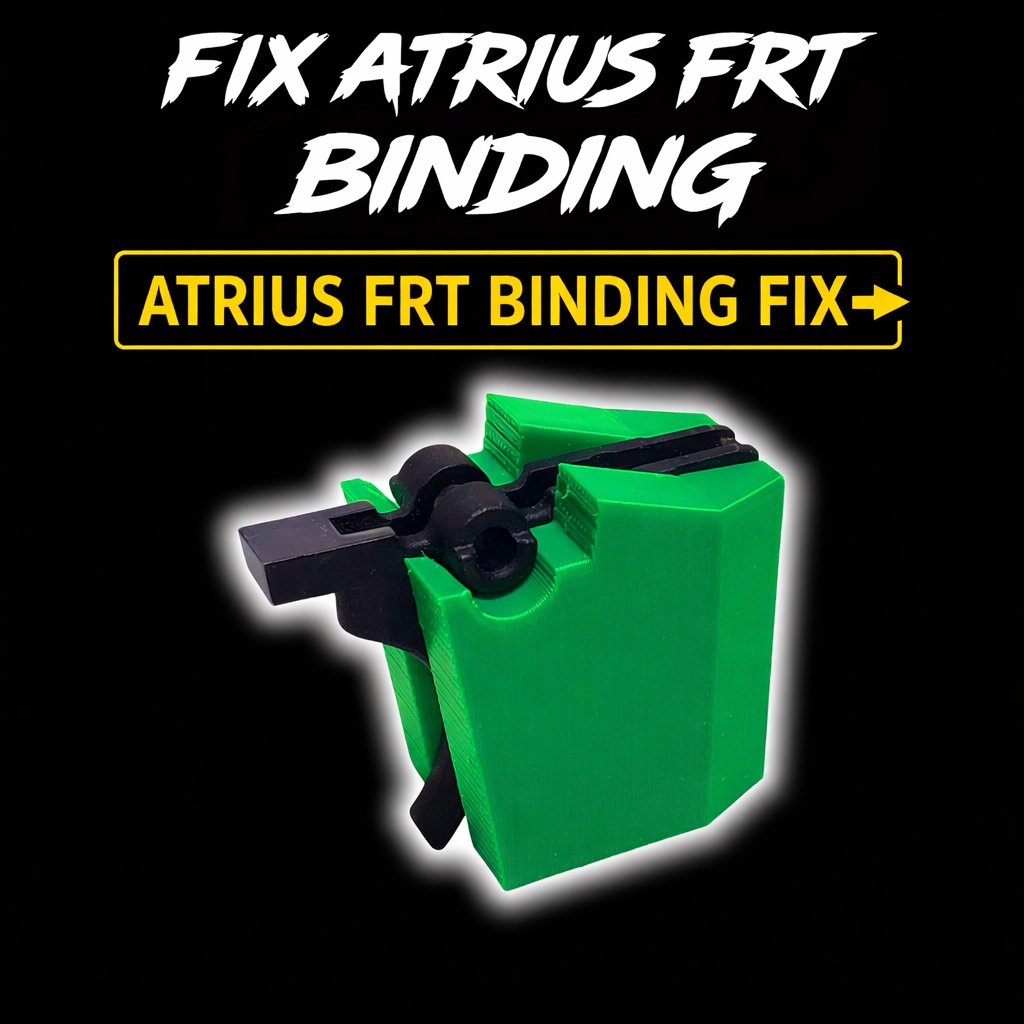
Most Atrius “drop-in” FRT systems suffer from binding, reset issues, or inconsistent performance — and it’s not user error.
These problems are not typically caused by user error, but instead stem from geometry and interaction between internal components.
In real-world use, many users encounter these issues even with proper installation and standard configurations.
This guide breaks down the most common Atrius FRT problems, why they occur, and how they can be corrected.
COMMON ATRIUS FRT PROBLEMS
Users frequently report the following issues:
- Trigger binding against the safety cam
- Failure to reset or inconsistent reset
- Rough or inconsistent cycling
- Premature wear or breakage of internal components
In many cases, users report resistance when cycling or difficulty moving the selector — both signs of mechanical interference within the system.
WHAT CAUSES THESE ISSUES
The primary cause is improper interaction between the rear of the trigger and the safety cam.
When the trigger geometry is not properly relieved:
- The trigger contacts the safety cam during cycling
- Resistance is introduced into the system
- Reset timing becomes inconsistent
This type of interference is one of the most commonly documented issues with Atrius-style systems.
WHY THIS HAPPENS
Atrius FRT systems rely heavily on precise geometry and component alignment.
This issue has been widely observed across multiple builds and configurations, especially in systems with tighter tolerances or standard mil-spec trigger geometry.
Even small variations in:
- Trigger shape
- Manufacturing tolerances
- Internal clearances
can result in:
- Binding during operation
- Increased stress on internal components
- Unreliable reset behavior
Because of this, even correctly installed systems may require modification to function properly.
COMMON SEARCHES RELATED TO ATRIUS FRT ISSUES
- atrius frt not working
- atrius frt not resetting
- atrius super selektor problems
- frt trigger binding fix
- atrius frt reliability issues
HOW TO FIX ATRIUS FRT BINDING
The most effective solution is to remove material from the rear of the trigger to eliminate interference with the safety cam.
This allows:
- Smooth interaction between components
- Reduced resistance during cycling
- Consistent and reliable trigger reset
Controlled material removal is the key — not excessive grinding, but precise correction of the contact surface.
WHY THIS FIX WORKS
By correcting the trigger geometry:
- The safety cam can move freely without interference
- Reset timing stabilizes
- Internal stress is reduced
This directly addresses the root cause of most Atrius FRT issues.
IMPORTANT CONSIDERATIONS
- Not all triggers behave identically
- Tolerances vary between manufacturers
- Over-removal of material can create new issues
In some cases, improper modification can result in unsafe conditions or incorrect selector function.
THE ROLE OF TUNING
Like many FRT systems, overall performance is also influenced by:
- Buffer weight
- Spring configuration
- Ammunition
Even with proper geometry, tuning may still be required for optimal function.
THE MOST COMMON MISTAKE
The most common mistake is either:
- Not removing enough material (binding remains)
- Removing too much material (creates safety/function issues)
The goal is controlled, even removal — not aggressive grinding.
Got you — clean, copy/paste ready with separators 👇
TROUBLESHOOTING ATRIUS FRT ISSUES
If your Atrius FRT is not functioning correctly, you are not alone — many users experience similar issues due to known design limitations.
Common search-related problems include:
- Atrius FRT not resetting
- Atrius FRT binding on trigger
- Super Selektor not cycling properly
- Trigger getting stuck or inconsistent reset
- Poor performance compared to other FRT systems
These issues are almost always caused by improper trigger geometry interacting with the safety cam.
Correcting this geometry is the key to restoring proper function.
FINAL THOUGHTS
Atrius FRT systems are highly sensitive to geometry and setup.
Binding issues are common, but they are also correctable.
With proper modification and setup:
- Function improves
- Reliability increases
- Overall performance becomes more consistent
Understanding the root cause is the key to fixing the system correctly.
Without correcting this interference, the system will continue to bind regardless of tuning or lubrication.
FIX THE PROBLEM
👉 Fix Atrius FRT binding issues permanently with this trigger jig